Architectural & Period Healing Series
Japanese Healing Mural
Japanese Healing Mural
There is a very interesting story connected to this mural:
# The Japanese Healing Mural
## A Mission, BC Reconciliation Story
Doug Cariou’s Japanese Healing Mural was born out of prayer, history, and a deep burden for reconciliation in Mission, British Columbia.
The story began about a year before a large evangelical tent meeting was planned for the city. Doug and a small group of men had been asked to pray over Mission every week in preparation. Their prayer meetings grew into many hours each week, and as they prayed, Doug says God began revealing hidden wounds in the city’s past.
One early morning, around 5 a.m., Doug and an older godly man named Jake McKee drove up near Cedar Valley Connector Road, around Cedar and Cherry. While they were praying, Doug says he suddenly saw an open vision: Japanese lettering stretched across the sky in blood red. He did not understand the words, but he knew in his spirit that they were Japanese.
Jake felt they needed to go immediately to the Mission Archives. Though it was very early, they went, knocked on the door, and found a woman working inside. Doug told her what he had seen and explained that they had been praying for the spiritual condition of Mission.
As he described the blood-red Japanese lettering, the woman became visibly moved. She went into another room and returned with a newly completed book about the treatment of Japanese Canadians in Mission during the Second World War. She opened it and showed him the lettering. Doug recognized it as the same kind of lettering he had seen in the vision.
Then she brought out a map of Mission. Much of it was marked in red. She explained that the red areas represented land that had been taken from Japanese Canadian families during the internment period. Many of these families had lived in Canada for decades. Some had served Canada in the First World War. Yet during the Second World War, they were uprooted, removed from their homes, and sent away to internment camps.
Doug came to understand that Mission carried a deep wound connected to this injustice. The mural would not simply be a painting. It would become a visual act of remembrance, repentance, and reconciliation.
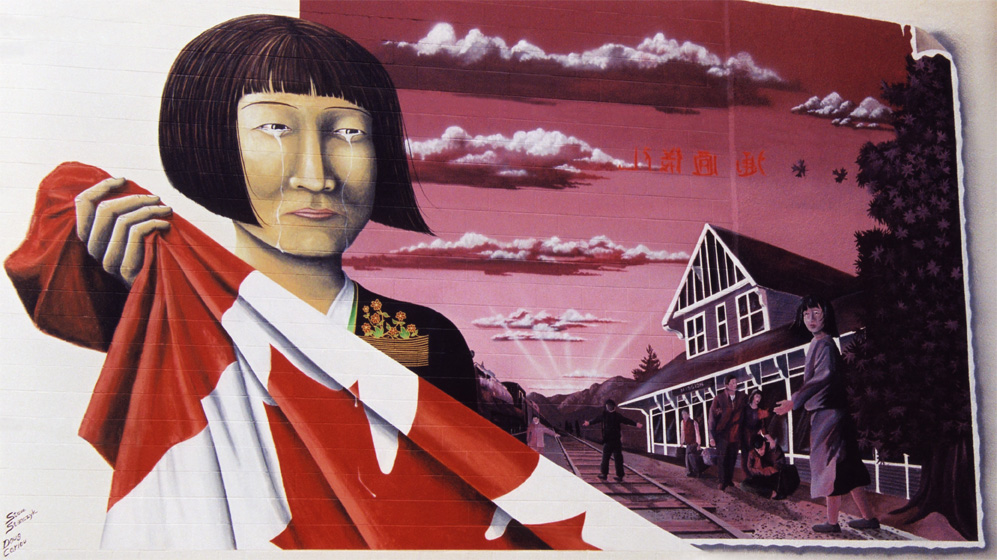
The mural shows the old Mission train station, where Japanese Canadian families were gathered and taken away. In the background are the people being placed on trains, removed from their homes and community. The blood-red Japanese lettering appears in the sky, echoing the vision that first awakened Doug to the story. The mural also includes the sense of the land itself crying out — land that had been taken, marked, and remembered.
In the foreground stands a Japanese woman holding the Canadian flag. Tears fall onto the flag, symbolizing the grief of a people who had trusted Canada, only to experience betrayal. In Doug’s telling, she represents the pain of the Japanese Canadian families who were forced out, and also the sorrow of the few who ever returned.
As Doug and the prayer group continued, they felt that reconciliation needed to happen publicly. It was not enough for the story to be hidden away in archives or whispered in private. There needed to be a visible witness: a mural on the wall, and a public act of repentance before the church and the community.
At first, there was no wall and no clear way to make the mural happen. Doug says he refused to force it. If it was truly God’s work, God would open the door.
A short time later, two Christian businessmen from Vancouver contacted him. They owned a building on Railway Street, across from where the old railway station had stood, and they wanted a mural painted there. They told Doug they wanted the mural to involve the Japanese and the railroad. Doug challenged them, saying that if the mural was about the building of the railroad, historically that would point more to the Chinese workers. But when he told them the full story of the vision, the archives, the red map, and the internment wound in Mission, they broke down crying. They believed God had sent them to provide the wall.
The mural began with a sense of timing that Doug saw as providential. His painting partner, Steve, called him just as Doug was about to call him. The day they began painting, news was breaking about Japanese people coming to British Columbia in connection with restitution and remembrance for wartime injustices. When the mural was completed, Doug was told it coincided with a major anniversary connected to Hiroshima and Nagasaki.
The mural also stirred opposition. Doug says one local businessperson threatened to have him jailed, but that conflict brought media attention. Global News came, and the story spread far beyond Mission — across Canada and into the United States.
Beside the mural, Doug and those involved placed a large written account explaining the story behind the image. It was not meant to be decoration. It was meant to tell the truth, expose a buried wound, and call the community toward healing.
Later, Mission City Hall recognized Doug and the mural. He recalls being honoured publicly, with RCMP officers present in their red serge uniforms. What had begun as a blood-red vision in the sky became a public work of memory, repentance, and reconciliation.
The Japanese Healing Mural stands as one of Doug Cariou’s most meaningful works: a painting that carries history, grief, prayer, and hope. It remembers the Japanese Canadian families of Mission whose homes and land were taken. It acknowledges the pain of internment. And it bears witness to the possibility that truth, once brought into the light, can become a doorway to healing.